0
0
Your shopping cart is empty.
Total: ${ $store.state.basket.data.itemSum | currency } (Gross) ${ $store.state.basket.data.itemSumNet | currency } (Net)
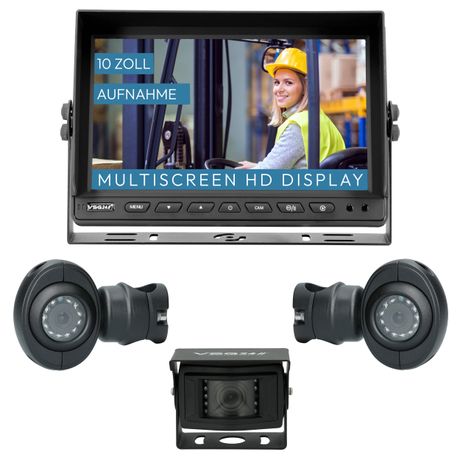 CABLE PROTECT PRO XL | 3CAM No chance for blind spots





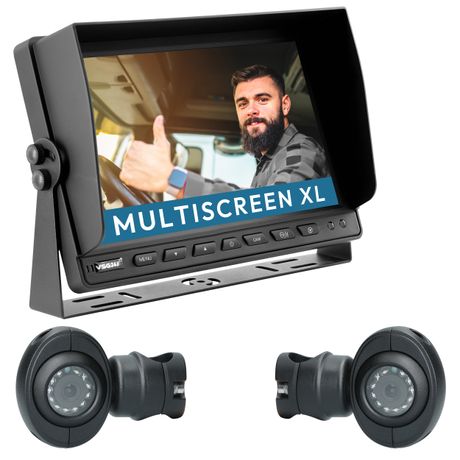 CABLE PROTECT XL | 2CAM Turn safely – no blind spots
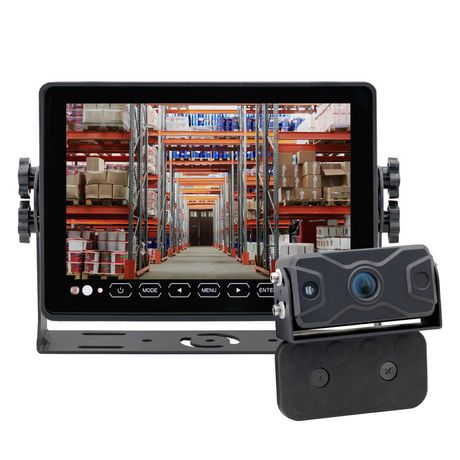 WIRELESS LASERGUIDE XPERT Forklift solution – magnetic mount – ready to operate instantly







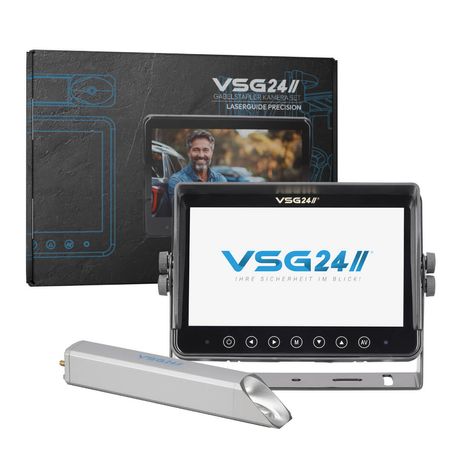 WIRELESS LASERGUIDE PRECISION Wireless forklift solution – strong magnetic hold – instantly installed
 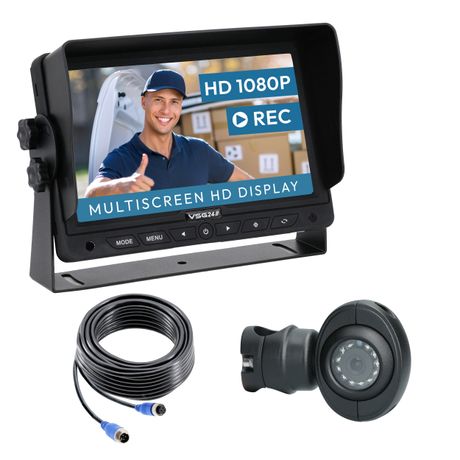 CABLE PROTECT Enhanced safety in your side mirror
A reversing camera for forklifts is a safety-relevant driver assistance system that improves visibility during internal transport processes. It helps operators with precise manoeuvring, safe reversing and accurate positioning of loads in high-bay warehouses.
For warehouse managers and fleet decision-makers, that means: more safety, fewer incidents, predictable operating costs.
Forklifts are among the most accident-prone vehicles in internal traffic. Typical risk factors include:
A single racking impact can quickly cost several thousand euros – not including production downtime, damaged goods or insurance consequences.
A professional camera system for forklifts significantly reduces these risks and also increases day-to-day precision.
Situation:
Consequences:
A forklift camera with laser marking helps align the tine position precisely and avoid incorrect storage placements.
Just one avoided damage event can fully pay back the investment in a camera system.
For high-bay warehouses and precise put-away processes, cameras with integrated laser guidance are particularly useful.
They enable:
With high throughput, this directly improves productivity and reduces damage rates.
Reversing cameras for materials handling vehicles are not a legal requirement, but they are considered a sensible technical measure to improve internal safety.
In the context of occupational safety and accident prevention, they can help to:
For businesses, this is a documentable investment in safety measures and risk minimisation.
A professional forklift camera system must:
In demanding logistics environments, durable components are crucial for long-term cost-effectiveness.
| System | Suitable for | Benefit |
|---|---|---|
| 1-camera system | Standard forklifts | Rear-area monitoring |
| Camera with laser | High-bay warehouses | Precise tine positioning |
| Multi-camera system | Complex logistics areas | Expanded fields of view |
Selection should be based on warehouse layout, throughput and incident risk.
A camera system is especially worthwhile if:
Here, a professional system supports not only safety, but also process stability.
Especially in B2B environments, reliability is crucial.
VSG24 stands for:
This keeps investments predictable and systems reliably operational over the long term.
This category is suitable for:
Not suitable for:
Specialised categories are available for these applications.
What is a reversing camera for forklifts?
A driver assistance system that improves visibility and precision in warehouse operations.
Why is it useful?
Because restricted visibility is a major accident and damage risk.
What should you look for?
Robustness, voltage range, laser option, continuous operation and expandability.
A professional camera system for forklifts reduces damage risks, supports operators with precise movements and increases operational safety.
For warehouse managers and fleet decision-makers, that means:
The full overview of all solutions can be found in the main category Rear View Systems.
For individual advice, the contact and advice page is available.
Discover robust camera systems for forklifts and materials handling vehicles – for safe and efficient logistics processes.
Forklifts often operate in tight areas, with restricted visibility and in close proximity to people. Reversing camera systems are among the most important safety-relevant driver assistance solutions in this setting, as they can make blind spots visible and help prevent collisions.
Especially when reversing, manoeuvring with loads or working inside warehouses, a camera system significantly improves overall awareness. This not only increases safety, but also efficiency, because manoeuvres can be carried out more calmly and precisely.
Typical risks in forklift operations include people in blind spots, poorly visible junctions inside halls, stacks of pallets or racking. Reversing systems make these hazards visible before situations become critical.
Particularly when forklifts are reversing or visibility is restricted by loads, a camera greatly increases the operator’s reaction time. This reduces property damage, personal injury and operational downtime.
Yes. High-quality reversing systems for forklifts are designed for both indoor areas (warehouses, production halls) and outdoor areas (yards, loading bays, construction sites).
VSG24 focuses on robust cameras with a high protection rating that can withstand dust, moisture and temperature fluctuations. This keeps the system reliable regardless of where it is used.
Laser aids are a valuable addition for forklifts. They project lines or points that can, for example, make fork tine position or safety distances visible.
Combined with a reversing camera, this creates a precise assistance system that makes accurate load positioning easier. It saves time, reduces incorrect manoeuvres and improves safety during put-away and retrieval.
Yes – wireless reversing systems are especially popular in the forklift sector. They enable fast retrofitting without complex cabling, which is ideal for existing vehicles or changing applications.
VSG24 uses stable 2.4 GHz wireless technology that has proven itself in industrial environments. The key is matching the system properly to the vehicle so the image remains stable.
Yes. For forklifts, wireless cameras with an integrated battery are particularly practical. These cameras do not require a fixed power supply and can be mounted flexibly – for example on different vehicles or in temporary deployment locations.
Magnetic mounts allow quick and secure fitting to metal surfaces. This greatly increases flexibility of use without compromising safety.
Monitor size directly affects how easily obstacles and people can be detected. In forklifts, 7-inch monitors have proven effective because they are easy to read without restricting the operator’s field of view.
Depending on the application, larger monitors may also make sense, for example with multi-camera systems. High brightness and a clear display are important so the image remains easy to see in changing light conditions.
Yes. Depending on the monitor, multiple cameras can be connected – for rear view, side areas or work zones. This increases overall visibility and significantly reduces blind spots.
Especially in complex warehouse layouts or on forklifts with special attachments, a multi-camera system is a sensible upgrade. Wired systems offer maximum stability, while wireless solutions provide flexibility.
Yes. Reversing systems can be integrated into existing safety concepts without difficulty and are a sensible complement to audible warnings or organisational measures.
They do not replace training or attentiveness, but they substantially improve visual control. In many businesses, they are an important part of modern occupational safety.
Forklifts differ widely in design, application and environment. A system that works outdoors is not automatically suitable for indoor warehouse use.
VSG24 provides targeted advice on forklift type, operating environment, mounting position and expandability. This results in a solution that makes day-to-day work safer and proves itself long term – rather than only working as a short-term fix.